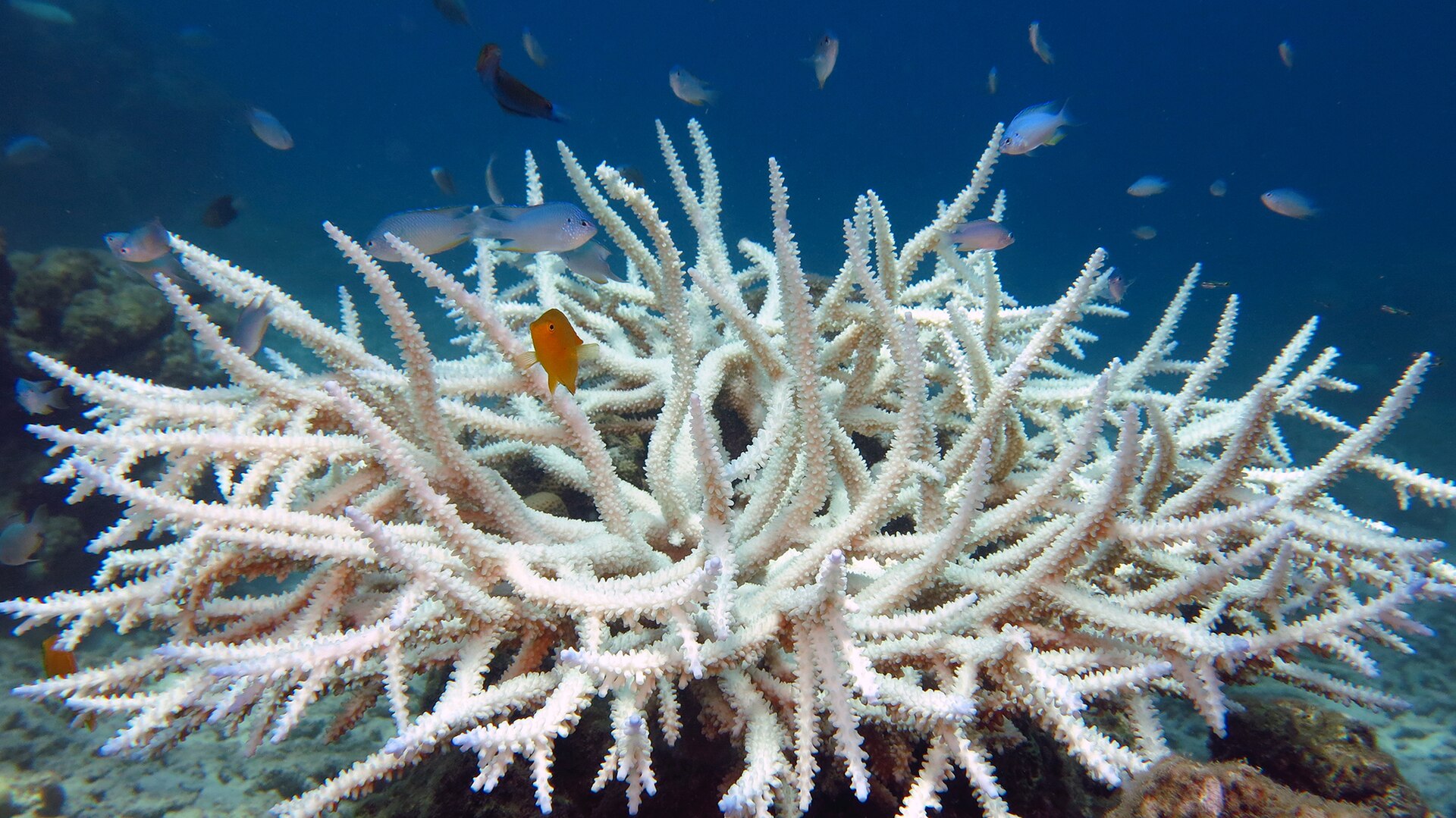
The fourth and most widespread global coral bleaching event on record has likely ended, the U.S. National Oceanic and Atmospheric Administration (NOAA) confirmed on 8 June 2026 through the Global Coral Reef Monitoring Network. Between early 2023 and mid-2025, bleaching-level heat stress affected an estimated 84 percent of the world's coral reef area across the Pacific, Atlantic and Indian Ocean basins, with mass bleaching documented in at least 83 countries and territories.
The event was officially declared by NOAA on 15 April 2024. It surpasses the previous record holder — the third global event of 2014–2017, which hit 68 percent of reefs — and dwarfs the first two events: 1998 (21 percent) and 2010 (37 percent).
How the call was made
NOAA's Coral Reef Watch confirmed the end of the event only after no widespread, large-scale bleaching was reported anywhere during the austral summer of December 2025 to February 2026. Severe bleaching off Western Australia in early 2025 likely bookended the global episode.
"We needed to confirm that no widespread, large-scale bleaching was reported anywhere during the austral summer which ran from December 2025 through February 2026, before we were confident the event had ended," said Derek Manzello, coordinator of NOAA's Coral Reef Watch. "We are now in the era where reefs will bleach on a near-annual basis, which means defining when global events begin and end is becoming increasingly difficult."
The peer-reviewed baseline
The end-of-event announcement lands four months after a Smithsonian-led international team published the first global retrospective on the previous record holder. Eakin et al., in Nature Communications (DOI: 10.1038/s41467-025-67506-w), analysed 15,066 reef surveys conducted during the 2014–2017 third global event and concluded that 51 percent of the world's reefs suffered moderate or worse bleaching and 15 percent moderate or worse mortality.
"This is the most geographically extensive analysis of coral bleaching surveys ever done," said Sean Connolly, a senior scientist at the Smithsonian Tropical Research Institute in Panama and one of the study's lead authors. "Nearly 200 co-authors from 143 institutions in 41 countries and territories contributed data."
"Our results show that the Third Global Coral Bleaching Event was by far the most severe and widespread coral bleaching event on record," Connolly added. "And yet, reefs are currently experiencing an even more severe Fourth Event, which started in early 2023."
His co-author Scott Heron, professor of physics at James Cook University, told the Smithsonian: "Around half of reef locations affected by bleaching-level heat stress were exposed twice or more during the three-year event — often with devastating consequences."
What comes next
NOAA has warned that the expected emergence of El Niño in the coming months will raise ocean temperatures and could bring a return to widespread bleaching, with a high risk flagged for much of the north Pacific including Hawaiʻi, and for Florida and the Caribbean later in 2026. Since 1998, every strong El Niño has coincided with a global bleaching event.
OceanVines lens
The investable read: between 1998 and 2026, the share of the world's reefs experiencing bleaching-level heat stress during a global event moved from 21 percent to 84 percent. Coral reefs underpin an estimated USD 9.8 trillion of annual ecosystem-service value and protect coastlines from Maldives to Manila. Any climate-transition, sovereign-debt or blue-bond model that assumes static reef cover is now demonstrably mis-priced.
For ocean education, the fourth global event is a generational data point. Children growing up in 2026 will know reefs as ecosystems that bleach on a near-annual cycle. Teaching them what coral is, why it matters and how to measure recovery is no longer optional.
This is aligned with OceanVines' mission: to illuminate the inner sparks of every life we touch through our efforts in ocean conservation and education.
Together, we celebrate The Greatest Good.