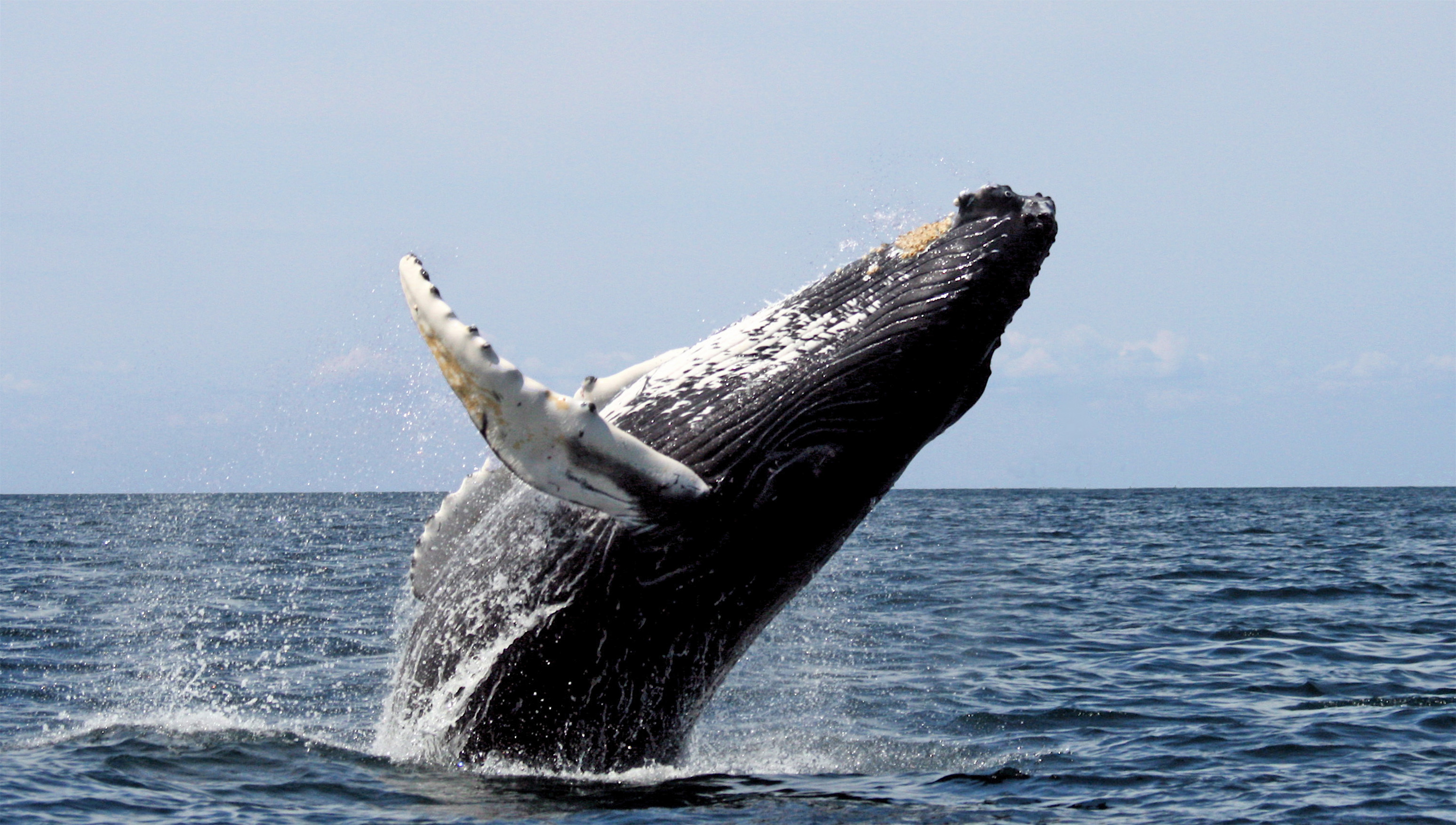
An international team of scientists has, for the first time, documented humpback whales travelling between breeding grounds in eastern Australia and Brazil — confirming a one-way distance of at least 15,100 kilometres between sightings of the same individual, the longest such movement ever recorded for the species (Phys.org / Griffith University).
The findings were published in Royal Society Open Science (DOI: 10.1098/rsos.260251). The minimum straight-line ocean distance between the two breeding grounds is about 14,200 kilometres — roughly the distance from Sydney to London. From a database of 19,283 high-quality fluke photographs collected between 1984 and 2025, just two whales — 0.01 per cent of nearly 20,000 individuals — were matched between Brazil and eastern Australia.
How they tracked it
The method is photo-identification: humpbacks are identified by the unique coloration and trailing-edge patterns on their tail flukes, the same way a fingerprint records identity. One whale was first photographed in Hervey Bay, Queensland in 2007, resighted in the same area in 2013, and then off the coast of São Paulo, Brazil in 2019. The second was first photographed in 2003 at the Abrolhos Bank — Brazil's main humpback nursery off Bahia — and was spotted again, alone, in Hervey Bay, Australia in September 2025 (Oceanographic Magazine).
What enabled the match was the photographic infrastructure: an integrated photo-ID library and the citizen-science platform Happywhale, which lets divers, tourists and scientists upload images that algorithms then attempt to match against a global index of known individuals.
Quotes from the research team
"Discoveries like this are only possible because of investment into long-term multi-decadal research programs and international collaboration. These whales were photographed decades apart, by different people, in opposite parts of the world, separated by two different oceans, and yet we can connect their journey." — Stephanie Stack, PhD candidate, Griffith University, and co-author on the study (Phys.org)
"Despite their rarity, these exchanges matter for the long-term health of whale populations. Occasional individuals moving between distant breeding grounds can help maintain genetic diversity across populations and may even carry new song styles from one region to another — humpback whale songs are known to spread culturally across ocean basins, much like music trends in human populations." — Stephanie Stack, PhD candidate, Griffith University (Phys.org)
"This kind of research highlights the value of citizen science. Every photo contributes to our understanding of whale biology and, in this case, helped uncover one of the most extreme movements ever recorded." — Dr. Cristina Castro, lead researcher, Pacific Whale Foundation (Phys.org)
Why this matters for conservation
The investable read: humpback populations are not the sealed compartments managers have historically modelled them as. Even a 0.01 per cent inter-ocean exchange rate matters because it sustains genetic flow and possibly cultural transmission across populations that climate change is squeezing in different ways. Authors flagged shifts in sea ice and the distribution of Antarctic krill as plausible drivers of long-distance movement.
For Asian waters, the practical implication is straightforward. Humpback populations migrating along the East Asian flyway — Okinawa, the Philippines, Taiwan, the South China Sea — share the same management logic. Long-term photo-ID databases, citizen-science contributions and standardised metadata are what convert anecdote into evidence. A photograph from a Hong Kong-flagged research vessel can, in principle, be matched a decade later against an image taken off Japan, Tonga or — as this study now shows — Brazil.
The new humpback record is a clean demonstration of how long-term marine mammal data series anchor credible ocean conservation: 41 years of fluke photos collapsed two oceans of uncertainty into one verified line on a map.
OceanVines lens
For a Hong Kong ocean charity, the policy and education takeaways converge. Citizen science is not an add-on; it is core conservation infrastructure. Schools, recreational divers, ferry operators and even tourists with phones are now part of the data pipeline. OceanVines' Sea Tiger programme — putting students and educators on the water — exists precisely to convert that exposure into structured observation.
This is aligned with OceanVines' mission: to illuminate the inner sparks of every life we touch through our efforts in ocean conservation and education.
Together, we celebrate The Greatest Good.