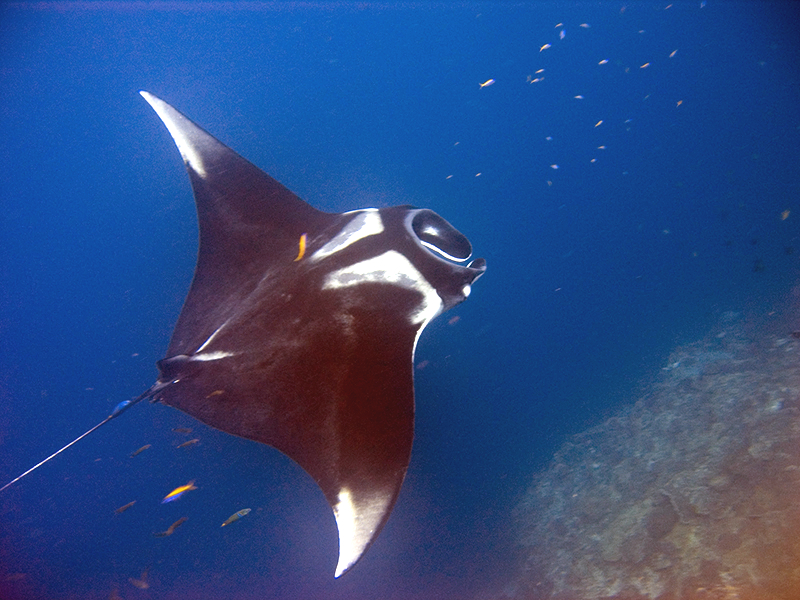
More than 800 researchers and conservationists from over 70 countries gathered in Colombo, Sri Lanka, from May 4–8 for Sharks International 2026 — the world's largest shark and ray science conference, held in Asia for the first time. The headline finding from the week was a quiet inversion of the conventional narrative: it is rays, not sharks, that now sit at the centre of the elasmobranch crisis.
Overfishing has halved global shark and ray populations since 1970, and more than a third of species are now threatened with extinction (Mongabay). The conference's significance is structural as well as numerical: held once every four years, Sharks International has previously been hosted in Australia, South Africa, Brazil and Spain. The 2026 Colombo edition — organised by Blue Resources Trust — was deliberately positioned to surface Global South science and fisheries realities.
Why Asia, why now
"The Indian Ocean is both a biodiversity hotspot and one of the world's most heavily exploited shark fishing regions," Daniel Fernando, co-founder and director of fisheries and policy at Blue Resources Trust, told Mongabay ahead of the conference. Sri Lanka itself records approximately 105 species of sharks and rays in its waters, yet only five currently receive legal protection — and local extinction of sawfishes has already been documented.
Fernando also flagged a structural barrier the conference was built to address: representation. He noted that participation from Global South scientists has historically been "limited" by visa and financial barriers, and said SI2026 responded with registration subsidies, a record number of travel grants, and a host country with streamlined visa accessibility.
The ray inversion
Dalhousie University's "Uncovering the Global Shark Meat Trade" project debuted preliminary findings showing the meat trade — long overshadowed by fins in conservation discourse — was worth $2.6 billion from 2012–2019, against $1.5 billion for fins over the same period, according to a 2021 WWF reference cited at the conference. The team also presented estimates that nearly twice as many rays — 191 million — are killed annually compared with the long-cited figure of 100 million sharks (Mongabay).
Reporting on FAO data gaps, project leader Aaron MacNeil of Dalhousie was blunt about where the trade-data problem concentrates: "More than 50% of the underreporting of species that happens to FAO happens just with five countries … Nigeria, Japan, Indonesia, China and Argentina," MacNeil said during a conference talk.
The headline reframing came from the chair of the global authority on the group. While 33% of shark species are threatened with extinction, the figure rises to 36% for rays overall and 69% for reef-associated rays. "Rays in every metric, essentially, are more in trouble than sharks," Rima Jabado, chair of the IUCN's Shark Specialist Group, said in a talk. "They're not usually considered in national legislation or regional legislation frameworks. Most NGOs don't even note them as priority species in conservation plans."
The science-to-policy gap
Conservation tools — trade regulation, fisheries monitoring, electrical bycatch deterrents, eDNA, satellite tagging, baited underwater remote video — are becoming cheaper and more available. The bottleneck is governance. The IUCN, the global authority for assessing species risk, notes that one-third of sharks and rays remain threatened, but only a small subset of those species are listed under CITES, the global wildlife trade regulator.
Conference participants flagged misidentification as a real-world enforcement problem. Researchers reported that, after COVID-19, some Indonesian restaurants pivoted to selling fins from critically endangered rhino rays as shark fin soup without labelling — collapsing the species-level signal needed for trade controls.
Chris Mull, a marine ecologist at Dalhousie University, framed the cultural dimension of the gap: "I think people, sadly, don't really care as much about rays, unless they're the big charismatic species. But there's a huge diversity and fishing pressure and also extinction risk of a lot of these coastal species of rays," he told Mongabay.
OceanVines lens
For a Hong Kong-based ocean charity, three implications stand out. First, the centre of gravity for elasmobranch fieldwork now sits in Asia — and any credible regional ocean-literacy programme should reflect that. Second, the unit of attention must shift from charismatic species to fisheries and trade-chain governance, where the leverage actually is. Third, the rays story is a reminder that conservation budgets concentrate on species the public already recognises; closing that gap is education work.
That is consistent with OceanVines' mission: to illuminate the inner sparks of every life we touch through our efforts in ocean conservation and education.
Together, we celebrate The Greatest Good.