California communities spend more than $428 million a year cleaning up and controlling plastic pollution — a recurring bill for a problem that, globally, is still not measured in a consistent way. That mismatch is now at the centre of a quiet policy push in the US state: build a common monitoring framework for plastics and microplastics, then use it to steer enforcement and investment.
The California Ocean Protection Council (OPC) said it is seeking feedback on a draft Statewide Plastics Monitoring Strategy and Planning Framework, aimed at tracking both macroplastics and microplastics across freshwater, estuarine and marine ecosystems. The public comment window, hosted with the San Francisco Estuary Institute, closed on March 11, according to the OPC’s plastics programme page. The point is less paperwork than comparability: without shared methods, a “decline” in one dataset can be an “increase” in another.
The stakes are not abstract. The United Nations estimates the world produces 430 million tonnes of plastic annually, and warns that “the estimated 11 million metric tons of plastic currently entering the ocean annually will triple in the next twenty years” without urgent action. For regulators, that trajectory turns monitoring into early-warning infrastructure — the difference between reacting to beach debris and tracking the upstream systems that feed it.
From Cleanup Costs to Data Standards
OPC frames the problem in fiscal terms as well as ecological ones: “California communities are estimated to spend more than $428 million annually to clean up and control plastic pollution,” it says, noting that plastics break down into micro- and nanoplastics rather than fully degrading. The Council describes its water-quality work as a mix of interagency coordination and research support — the kind of back-office capacity that determines whether regulations have teeth.
The draft monitoring framework is the follow-on to what OPC calls a first-of-its-kind Statewide Microplastics Strategy, adopted in 2022 under Senate Bill 1263. That strategy sets out a two-track approach: “solutions” — eliminating plastic waste at the source, interrupting pathways like stormwater and wastewater, and public education — and “science to inform future action,” including statewide monitoring and risk thresholds.
For investors and philanthropies that have poured money into cleanup devices and shoreline programmes, the implication is uncomfortable: monitoring is the unglamorous prerequisite for knowing whether downstream spending is working.
What the Science Says — and What It Still Can’t
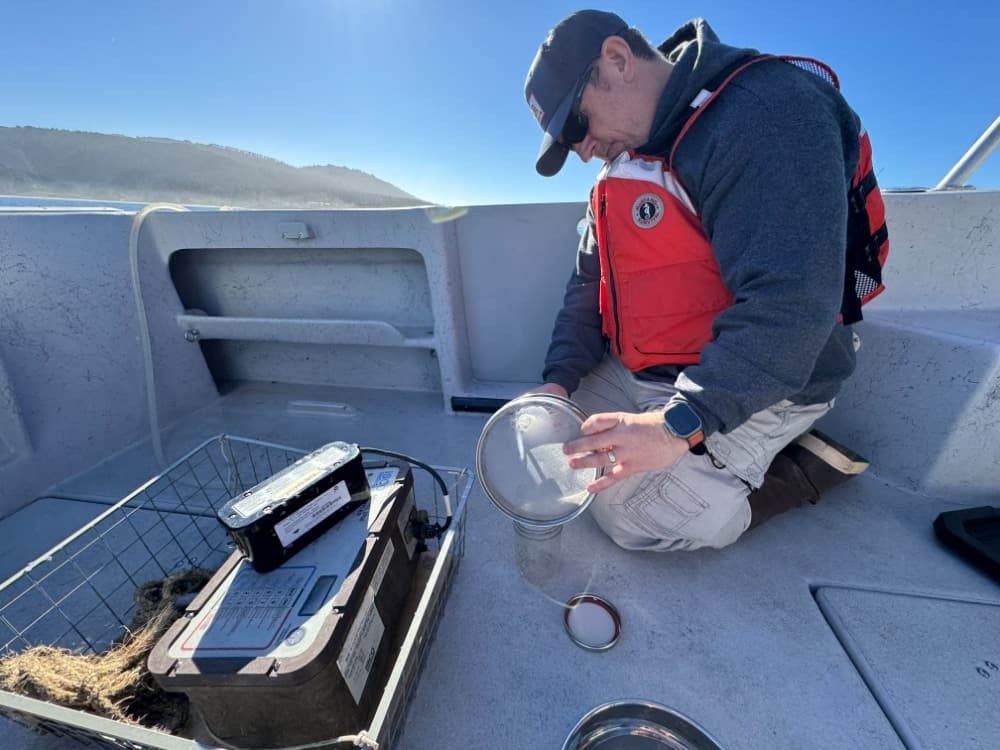
One reason consistent monitoring matters is that microplastics are defined by size, not origin. NOAA’s Monterey Bay National Marine Sanctuary described microplastics as “small plastic pieces or fibers that are less than 5 millimeters in size,” and said they can come from sources ranging from textile microfibers to fragments of bags and bottles. In a recent sanctuary field project, researchers and citizen-science volunteers collected beach sand and nearshore water samples and separated particles into two size classes — from 50 to 500 microns, and from 500 microns to 5 millimeters — before visual sorting and infrared spectroscopy for smaller pieces.
That methodology points to a broader issue: the units that matter to scientists are often not the units that matter to decision-makers. A coastline can look “clean” while microplastic concentrations rise in sediment, or while specific polymers tied to an industry cluster spike upstream. Standardised sampling, and publishing it in a way that agencies can compare, is a step toward turning laboratory outputs into policy levers.
“Microplastics are small plastic pieces or fibers that are less than 5 millimeters in size … and can come from a variety of sources.” — Amity Wood, Education and Outreach Coordinator, Monterey Bay National Marine Sanctuary (NOAA)
A Global Problem, a Local Playbook
The wider policy clock is ticking. The UN notes plastics account for at least 85% of marine litter, and that production is still growing. Meanwhile, the International Maritime Organization has set a vision of “zero plastic waste discharges to sea from ships by 2025” under its strategy to address marine plastic litter from ships — a reminder that ocean plastics policy now spans land-based packaging, river transport, and sea-based sources like shipping and fishing gear.
“The Strategy sets a vision to ‘… endeavouring to achieve zero plastic waste discharges to sea from ships by 2025’.” — International Maritime Organization, on its marine plastic litter strategy
California’s framework will not solve the global problem, but it does signal how the next phase of stewardship may evolve: fewer one-off cleanups, more measurement, and a tighter link between data and who pays. Extended producer responsibility laws, like California’s SB 54 referenced by OPC via CalRecycle, shift costs upstream. Monitoring is what makes those cost shifts defensible.
OceanVines exists “to illuminate the inner sparks of every life we touch through our efforts in ocean conservation and education.” If microplastics are the invisible pollutant of this decade, then measurement is the start of stewardship: it equips communities, scientists and policymakers to argue from shared facts — and to teach the next generation what accountability looks like in water as well as on land.
What to Watch Next
The next test for monitoring frameworks is whether they can move beyond pilot projects. That means repeating sampling over seasons, publishing results in machine-readable formats, and building budgets that last longer than a grant cycle. It also means confronting the politics of thresholds: when a concentration becomes “unsafe,” and for whom.
For now, California’s approach offers a pragmatic lesson: you cannot manage what you do not measure, and you cannot measure what you do not agree how to count. Together, we celebrate The Greatest Good.